My 10 Non-Negotiables as a College Student with Type 1 Diabetes (No CGM Edition)
My 10 Non-Negotiables as a College Student with Type 1 Diabetes (No CGM)
Disclosure: Some of the links in this post are affiliate links, which means I may receive a small commission if you purchase through them, at no extra cost to you. As an Amazon Associate I earn from qualifying purchases.
Quick Summary
This post is a look at the ten things I rely on every day as a college student managing type 1 diabetes in the Caribbean without a CGM. It is written for other students with T1D, for parents who are sending a child off to school or university, and for anyone newly diagnosed who is wondering what a realistic, manual routine actually looks like. You will find the essentials, why each one earned its place, and a few practical tips along the way.

Key Takeaways
You can manage type 1 diabetes without a CGM, but it takes a consistent routine, regular fingerstick checks, and a well-stocked kit.
A small, always-packed pouch makes it much easier to stay prepared at school, at work, and on the go.
Ketone strips matter most for people who see more frequent highs, which is common with manual monitoring.
A fast-acting low snack and an emergency ID are small items that carry a lot of safety value.
Personal extras, like a sugar-free sweetener or a scale, are worth including only if they genuinely support your health and feel good to use.
Every person's list will look a little different, and your care team should guide the specifics of your own plan.
Introduction
If you're new here, you may already know that I'm part of the "CGM-less" gang. It isn't intentional. A continuous glucose monitor (CGM) is a small sensor that tracks glucose throughout the day and night, and where I'm from, it simply isn't accessible. That is the reality for many people with T1D in many countries around the world, and it is a big part of why this post, along with a number of others for the time being, centers on manual glucose management.
Forgive my ramble, but I wanted you to know where I'm coming from before we get into the list. Below are the things I use and truly need as a college student managing type 1 diabetes in the Caribbean without a CGM. I've split them into two groups: the necessities, which are the absolute no-brainers for most people with T1D, and a few items that are a little more specific and personal to me.
If you're a parent or a friend reading this because someone you love has T1D, I hope it gives you a clear picture of what daily life can look like. If you're newly diagnosed, please know that you don't need everything on this list on day one. Your care team can help you decide what to start with.
Without further ado, let's get started.
The Necessities
1. Insulin
Yes, I had to put this one on the list. My insulin pens are non-negotiable, because the body no longer makes its own insulin when you live with type 1 diabetes. I use one rapid-acting pen, which works at mealtimes, and one long-acting pen, which works in the background, and I always keep a spare on me in case something happens to the one I'm using.
Obviously I carry my pens with me everywhere I go. Taking my rapid-acting insulin ahead of meals (called prebolusing) and my long-acting dose (basal) are no-brainers in my routine, though everyone's timing is different, so it's best to follow your own care team's guidance.
A few habits that make a difference, especially in a warm climate:
Keep track of how much you have left, and reorder before you reach your last pen rather than after.
Store it according to the label. Unopened insulin is typically kept in the refrigerator, and insulin in use usually has a set number of days it can stay at room temperature, which varies by product. Your pharmacist can confirm the details for your specific insulin.
Avoid leaving it in direct sun, in a hot car, or on a sunny windowsill, since heat can affect how well it works.
Using my Health Management Dashboard, I keep track of how many units I take daily, and that information becomes really beneficial when assessing care plans and health impacts
2. Glucometer and Test Strips
Without a CGM, my glucometer is my window into what is happening in my body. A glucometer is the small device that reads the blood sugar from a drop of blood placed on a test strip.
A glucometer is the small device that reads the blood sugar from a drop of blood placed on a test strip.
I use the Code Free glucose meter and test strips
Fun fact: I got my glucometer free through a health program subsidized by my government, the NHF and, I through said program I also get my strips subsidized.
A few practical notes:
Always check the expiry date on strips, since expired strips can give less reliable readings.
Diabetes organizations commonly suggest checking at times such as before meals, before bed, before exercise or driving, when you feel unwell, and after treating a low. How often is right for you is a conversation to have with your care team.
3. Lancets, a Lancing Device, and Prep Wipes
The lancing device is the small pen-like tool that holds a lancet, which is the tiny needle that pricks your finger. These are the quiet workhorses of a manual routine, and with no CGM, they get used a lot.
I keep prep wipes with them too, and I use them to clean the surface of my skin before I inject, which helps clear bacteria from the area. They are exactly what they sound like, and they are a no-brainer.
Tip: Rotating which fingers you use, and pricking along the sides of the fingertip rather than the center pad, tends to be more comfortable over time.
Fun Fact: I sometimes also use my toes 🤭
4. Needles
I like thse particular needles I use because the size makes my injections painless. Needle comfort can make a real difference to how you feel about injecting several times a day, and it is worth asking your care team about the length and gauge that suit you.
Tip: Keep a small sharps container, or a sturdy plastic container with a secure lid, for used needles and lancets, and check your local guidelines for how to dispose of it safely.
5. Ketone Strips
Ketones are substances the body produces when it does not have enough insulin and starts breaking down fat for fuel. In large amounts, they can lead to diabetic ketoacidosis (DKA), which is a medical emergency.
Can I be a little honest? Because I don't use a CGM and, realistically, I can't prick my finger at that level each day, I sometimes experience a number of high readings. That is the drawback. Not knowing when and how something has affected your levels means highs can go unnoticed for longer. Eating and doing the same things each day tends to produce more predictable results, which makes a steady routine easier to manage, but not always, because diabetes rarely makes things easier on us. All of that to say, I will see high readings a little more often than I would like, and with that comes the risk of ketones, which is exactly why these strips earn a permanent place on my list.
General guidance from diabetes organizations is to check ketones when you are unwell or when blood sugar stays high, often above 250 mg/dL (13.9 mmol/L). If ketones are moderate or high, or you have vomiting, abdominal pain, deep fast breathing, or fruity-smelling breath, contact your care team or go to the emergency room right away.
If you'd like a closer look at highs, lows, and DKA warning signs, I've written a full guide on hypoglycemia vs. hyperglycemia that you can find here:
6. A Fast-Acting Low Snack
Low blood sugar, usually a reading below 70 mg/dL (3.9 mmol/L), can come on quickly and needs treating right away. A low snack is a quick source of carbs for when my number drops mid-lecture, and I keep one within reach everywhere I go.
My favorite happens to be a Tocoloco chocolate bar. Fun fact: it is a local and Caribbean favourite. I also keep and use glucose powder to treat more severe lows.
The standard approach is the 15-15 rule: have 15 grams of fast-acting carbohydrate, wait 15 minutes, and recheck. Some options that provide about 15 grams are:
4 to 5 glucose tablets
About 4 ounces (half a cup) of juice
1 tablespoon of honey or sugar
Half a can of regular (not diet) soda
Many people like glucose tablets because the amount is precise and they keep well in a bag. Because chocolate contains fat, which can slow how quickly sugar is absorbed, and bars vary in carbohydrate content, check the label on whatever you choose and ask your care team what works best for you.
7. Emergency ID
If I ever have a severe low and cannot speak for myself, an emergency ID speaks for me. It tells first responders and bystanders that I have type 1 diabetes, which changes how quickly and how correctly they can help.
A medical ID bracelet or wallet card is ideal, and a card can include your condition, the insulin you use, an emergency contact, and your doctor's details. If a bracelet is not within budget, many smartphones also let you add medical information that can be viewed from the lock screen, which is a free and useful backup.
8. My T1D Pouch
My T1D pouch is a small kit that holds all of my on-the-go diabetes necessities: glucometer, strips, lancets, lancing device, wipes, extra needles, a low snack, and bolus (mealtime) insulin.
Anything works for this, really. Mine happened to come as an extra when I bought my bag, and I use it for school and, well, for everything. Keeping it packed means I never have to think about whether I have what I need when I leave the house.
The bag my pouch came with:
Tip: Pick one day a week to restock the pouch, and check expiry dates while you're at it.
More Personal
These are the items that are specific to me. You may not need them, and that is completely fine. I'm including them because they are part of how I look after my whole health, not only my glucose.
9. Lakanto Sweetener
I use Lakanto to sweeten drinks and porridge so that they stay sugar free. It lets me enjoy the foods I grew up with without adding sugar.
Sweeteners affect people differently, and some sugar alcohols can upset the stomach for certain people, so it's worth checking the label and noticing how your own body responds. If you're unsure whether a sweetener suits you, your care team or dietitian can help.
10. A Scale
For me, this one isn't only about a scale. It is about staying on top of every aspect of my health, including my weight.
Weight matters in type 1 diabetes for a few reasons. Unexplained weight changes can be a sign that blood sugar or insulin needs are shifting, and insulin dosing is often guided in part by body weight, so your care team may find your trend helpful at appointments.
Scale:
A gentle note for anyone reading: a scale should be a tool for noticing trends, not a source of stress. If weighing yourself ever feels heavy or triggering, it is completely okay to skip it and let your care team track it for you.
Honorable Mention: My Water Bottle
I'm adding my Owala water bottle here as a bonus, because staying hydrated matters when blood sugar runs high, and having water within reach makes it much easier to keep up.
At a Glance
# | Item | Why it earns a spot |
1 | Insulin | The one item that is never optional |
2 | Glucometer and strips | My main window into my glucose without a CGM |
3 | Lancets, device, and wipes | Used constantly in a manual routine |
4 | Needles | Comfortable injections make the routine easier |
5 | Ketone strips | Important because highs can go unnoticed longer |
6 | Fast-acting low snack | Treats a low quickly |
7 | Emergency ID | Speaks for me in an emergency |
8 | T1D pouch | Keeps everything ready to go |
9 | Lakanto sweetener | Keeps familiar foods sugar free |
10 | Scale | Helps me notice trends in my overall health |
For Parents, Partners, and Friends
If you're supporting someone with T1D, you don't need to memorize every item on this list. It helps most to know where their pouch and low snack are kept, to recognize the signs of a low and a high, and to know what to do in an emergency. If your loved one is heading off to school or university, offering to help restock their kit or set up a phone medical ID can be a quiet, practical way of showing care.
If you are newly diagnosed and still putting your own kit together, you are not behind, and there is no single right way to do it. Lynnove is exploring simple starter resources and printable logs for people managing diabetes with limited access to technology, and we would love to hear what would be most useful for you.
Living With This 🤍
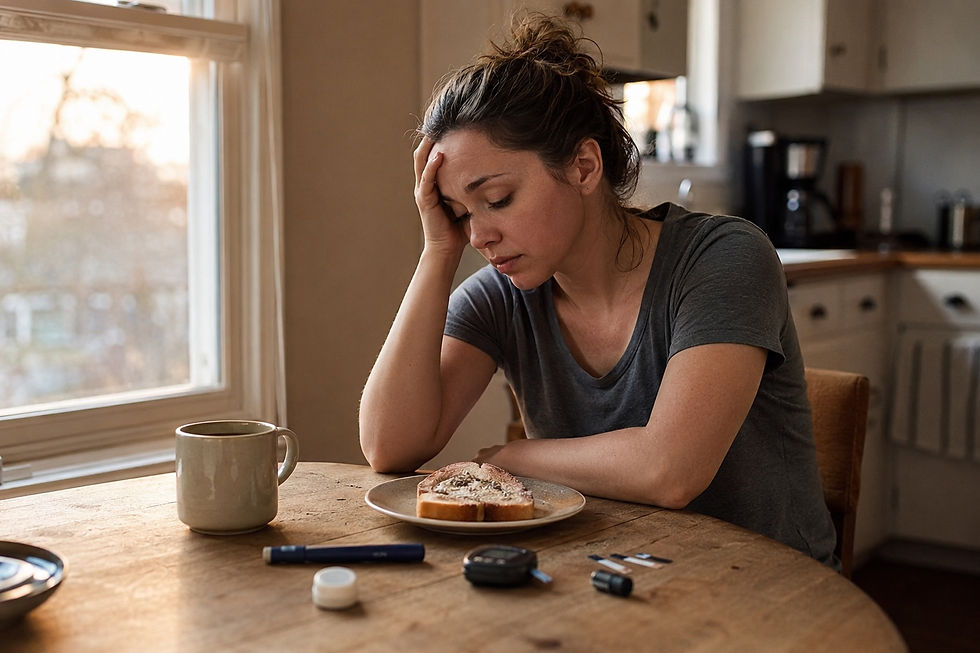
There is something that does not fit on a checklist, which is the mental weight of doing the job of a pancreas by hand, every single day. It is the finger pricks you decide are worth it and the ones you talk yourself out of because you are tired. It is the quiet worry when a reading comes back higher than you expected, and the effort of explaining to classmates or professors why you need to step out or eat in the middle of a lecture.
If you manage diabetes without the technology that others take for granted, that effort is real, and it deserves to be acknowledged. You are doing something difficult with the resources you have, and the fact that you are still showing up, still checking, still learning, matters more than any single number on a meter.
Key Takeaways (Recap)
Remember:
✔ You can manage T1D without a CGM, and a steady routine and a well-stocked kit make it easier.
✔ Ketone strips are especially valuable if you have frequent highs.
✔ A low snack and an emergency ID are small items with big safety value.
✔ Personal extras are only worth it if they support your health and feel good to use.
✔ Your list will look different from mine, and that is exactly how it should be.
Frequently Asked Questions
Can you manage type 1 diabetes without a CGM?
Yes. Checking blood sugar with a fingerstick and a glucometer is the traditional method, and it remains how many people around the world manage T1D. It usually means checking more deliberately at key times, so it is worth building a routine with your care team.
How often should I check my blood sugar without a CGM?
This depends on your insulin plan, your routine, and your care team's guidance. Many people check before meals and at bedtime, and more often when they are ill, exercising, or feeling unwell.
When should I check for ketones?
Diabetes organizations generally advise checking when you are sick or when blood sugar stays high, often above 250 mg/dL (13.9 mmol/L). Moderate or high ketones need prompt medical attention.
What should I keep in a T1D pouch?
A glucometer, test strips, a lancing device and lancets, prep wipes, extra needles, a fast-acting low snack, and mealtime insulin are a good starting point, adjusted to your own plan.
Are sugar-free sweeteners safe for people with type 1 diabetes?
Many people with T1D use sugar-free sweeteners as part of their routine, but products differ and individual responses vary. Check labels for carbohydrates and sugar alcohols, and ask your care team or dietitian if you are unsure.
When to Seek Medical Help
Contact your care team or seek emergency care if:
Ketones are moderate or high
You have vomiting, abdominal pain, deep or fast breathing, or fruity-smelling breath
Blood sugar stays high despite your usual correction plan
A low does not improve after repeating the 15-15 rule
Someone cannot swallow safely or is unconscious, in which case glucagon should be given if available and emergency services called immediately
Trusted Resources
American Diabetes Association (ADA), for Standards of Care and everyday management guidance
International Diabetes Federation (IDF), for global information on diabetes care and access
National Institute of Diabetes and Digestive and Kidney Diseases (NIDDK), for patient-friendly overviews
Centers for Disease Control and Prevention (CDC), for testing and monitoring basics
Beyond Type 1, for community-driven T1D support
A Note on Availability
Some of the products above are linked through Amazon and may not be available or deliverable in every country. If you cannot order them where you live, you can still use this list as a guide for what to look for locally, and your pharmacist or care team can often point you to equivalent supplies.
Conclusion
Managing type 1 diabetes as a college student without a CGM looks like a lot of small, steady habits, supported by a handful of dependable tools. These ten items are what help me feel prepared, safe, and a little more in control, and I hope they give you a starting point for building a kit that works for your own life.
Wherever You Are Today...
Whether you're newly diagnosed, have been living with diabetes for years, or are here supporting someone you love, I hope this post made the day-to-day feel a little clearer and a little less lonely.
Living with diabetes isn't always easy, but understanding it can make each step feel a little less overwhelming.
If you ever need support, someone to talk through your routine with, or simply a place to feel understood, please reach out to me. You don't have to figure this out alone.
Thank you for spending part of your day with Lynnove.
We're grateful you're here.
Here, your light always shines.
If this post helped you feel more prepared or a little less alone, consider sharing it with someone who may need it too, or save it for the next time you are restocking your kit.
You can also explore more diabetes education, practical guides, recipes, and wellness resources throughout Lynnove.
No pressure. Just an invitation.


Comments