Understanding Blood Sugar Basics
- Jul 15
- 5 min read

What blood sugar actually is, what counts as "normal," and everything that quietly shifts the number on your meter or CGM.
If you have ever stared at a number on a meter and thought, "okay, but what does this actually mean," you are not alone. Blood sugar gets talked about constantly in the diabetes world, yet so few of us were ever sat down and taught what it really is, why it moves the way it does, or what our bodies are doing behind the scenes. This week, we are going back to basics. Not the overly clinical, textbook version, but the version that actually makes sense in real life, whether you are the one living with T1D, the parent of a newly diagnosed child, a caregiver trying to keep up, or someone just starting to learn the language of this condition.
Consider this your foundation lesson. Everything else we build on in future weeks will come back to what you learn here.
What Blood Sugar Actually Is
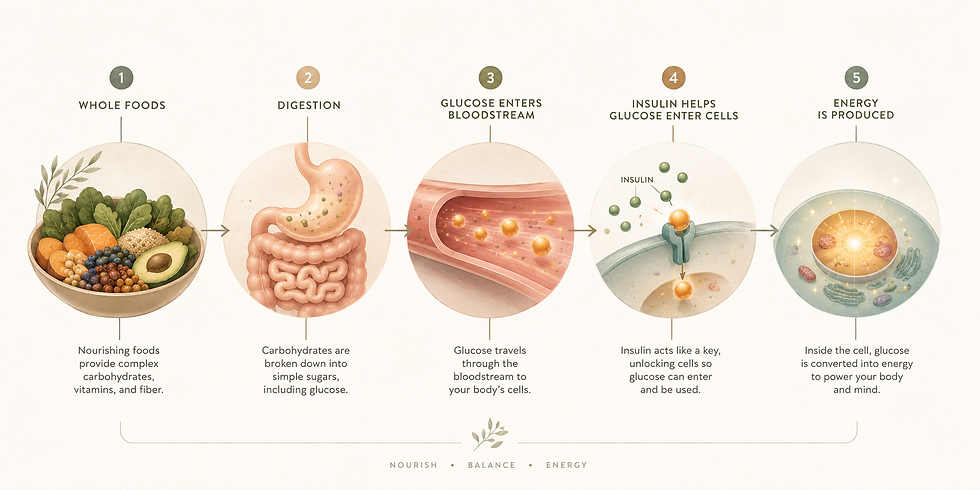
Blood sugar, or blood glucose, is simply the fuel circulating through your bloodstream at any given moment. Every time you eat, your body breaks food down into glucose, which enters your blood and travels to your cells to be used as energy. Your brain in particular depends on a steady supply of it. This is not something unique to diabetes. Everyone's body runs on glucose. What differs for those of us with T1D is how that glucose gets from the bloodstream into the cells that need it.
That is where insulin comes in.
The Two Hormones Running the Show

Your pancreas is home to two hormones that work in opposite directions to keep your blood sugar in a healthy range.
Insulin is made in the pancreas and acts like a key, unlocking your cells so glucose can move out of the blood and into the cells where it becomes usable energy. In a body without T1D, this happens automatically and continuously. In a body with T1D, the cells that make insulin have been affected by an autoimmune process, so insulin has to be given from the outside, through injections or a pump, to do the job the pancreas can no longer do on its own.
Glucagon works in the opposite direction. When blood sugar drops too low, glucagon tells the liver to release stored glucose back into the bloodstream, bringing levels back up. This is part of why a glucagon kit is such an important piece of emergency preparedness for severe lows.
Together, insulin and glucagon are meant to keep blood sugar steady. With T1D, that natural balance needs outside support, which is the entire reason dosing, carb counting, and monitoring exist.
What "Normal" Actually Looks Like

Numbers can feel overwhelming, so here is the simplified version.
Normal fasting blood sugar (for someone without diabetes) generally falls between 70 and 99 mg/dL.
Low blood sugar (hypoglycemia) is generally anything under 70 mg/dL.
A common target range for many people managing T1D is between 70 and 180 mg/dL, though your care team may set a range that is more specific to you or your child.
High blood sugar (hyperglycemia) varies depending on the person and situation, but consistently elevated numbers over time are what your care team watches closely.
If your target range looks different from what is listed here, that is completely normal. Ranges are individualized based on age, other health factors, and what your endocrinologist has recommended. What matters most is understanding your own personal target, not comparing it to someone else's.
What Actually Affects Blood Sugar

This is the part that often gets left out of the basics. Blood sugar is not only about food. So many factors quietly influence that number, and knowing them can take a lot of the guilt and confusion out of the equation.
Food, especially carbohydrates, has the most direct and immediate effect. Not all carbs move at the same speed though. Fiber-rich, whole food carbohydrates tend to raise blood sugar more gradually than refined or sugary ones.
Physical activity actually helps lower blood sugar, often independent of insulin, because moving muscles pull glucose out of the blood for fuel. This is one reason a short walk after a meal can genuinely help.
Sleep plays a bigger role than most people realize. Poor or inconsistent sleep can affect insulin sensitivity and make numbers harder to predict the next day.
Stress triggers hormones like cortisol and adrenaline, which can raise blood sugar even without eating anything at all. This is why a hard emotional day can sometimes show up on your CGM.
Illness and infection almost always raise insulin needs, sometimes significantly, because the body is fighting something and releases stress hormones as part of that response.
Hormonal shifts, including puberty, menstrual cycles, and pregnancy, can shift blood sugar patterns in ways that have nothing to do with anything you did wrong.
The dawn phenomenon is a natural early morning rise in blood sugar caused by hormones preparing your body to wake up. It happens to people without diabetes too, but for those of us managing T1D, it often needs to be accounted for in dosing.
None of this is about being perfect. It is about understanding that your body is responding to a lot more than what is on your plate.
A Note for Caregivers and the Newly Diagnosed
If you are new to this, whether newly diagnosed yourself or newly caring for someone who is, please hear this. You do not need to memorize everything in this post today. Understanding blood sugar is a slow, ongoing process, and even people who have lived with T1D for years are still learning. Give yourself grace as you take this in. The goal is not to get every number perfect. The goal is to understand your body, or your loved one's body, a little better each week.
Why This Foundation Matters
Everything else we cover in this education series, carb counting, correction factors, exercise planning, sick day management, will build on what you learned today. Blood sugar basics are the foundation the rest of your toolkit sits on. Once you understand what is actually happening in your body, the rest starts to make a lot more sense.
If you want a simple place to keep track of your own numbers, patterns, and notes as you learn, our Health Management Dashboard was built exactly for this. It is a place to track the practical alongside the personal, and to actually see your own patterns over time instead of trying to hold it all in your head.
Wherever you are in this journey, whether you are three days in or three decades in, please know that you do not have to figure this out alone. If you need someone to talk to, have questions about something specific to your situation, or just want support from people who understand, reach out to us any time. We are here for you.
With love and care,
Lynnove 🤍



Comments